
Bellwether, 1885
Welcome to Bellwether
Credence Bellwether is dead. The city, his namesake and life’s work, balances on a knife’s edge between prosperity and chaos.
While this great man lived, Bellwether grew in peace and prosperity. Without his influence, workers, officials, and the gangs of the city are thrust suddenly into a power vacuum. Minor barons, you among them, swoop in to claim their share of that power and wealth.
The industrial revolution is at hand.
Workers have begun to consider their rights in this new world of progress. Powerful city officials look to make lucrative deals for their support. In darkened alleys, crime has begun to organize and flex its muscle over the city.
Can you seize the city without letting it fall into riot and revolution?
The object of the game
Win the city—or survive its fall
Consolidation
At the end of Labor, control at least 3 non-rioting Wards and hold at least 10 Influence.
Revolution
If every claimed Ward is in Riot, the city falls immediately. The player with the greatest Net Worth wins.
A Ward is claimed once it contains a player-owned Building. Empty Wards are ignored when checking for Revolution.
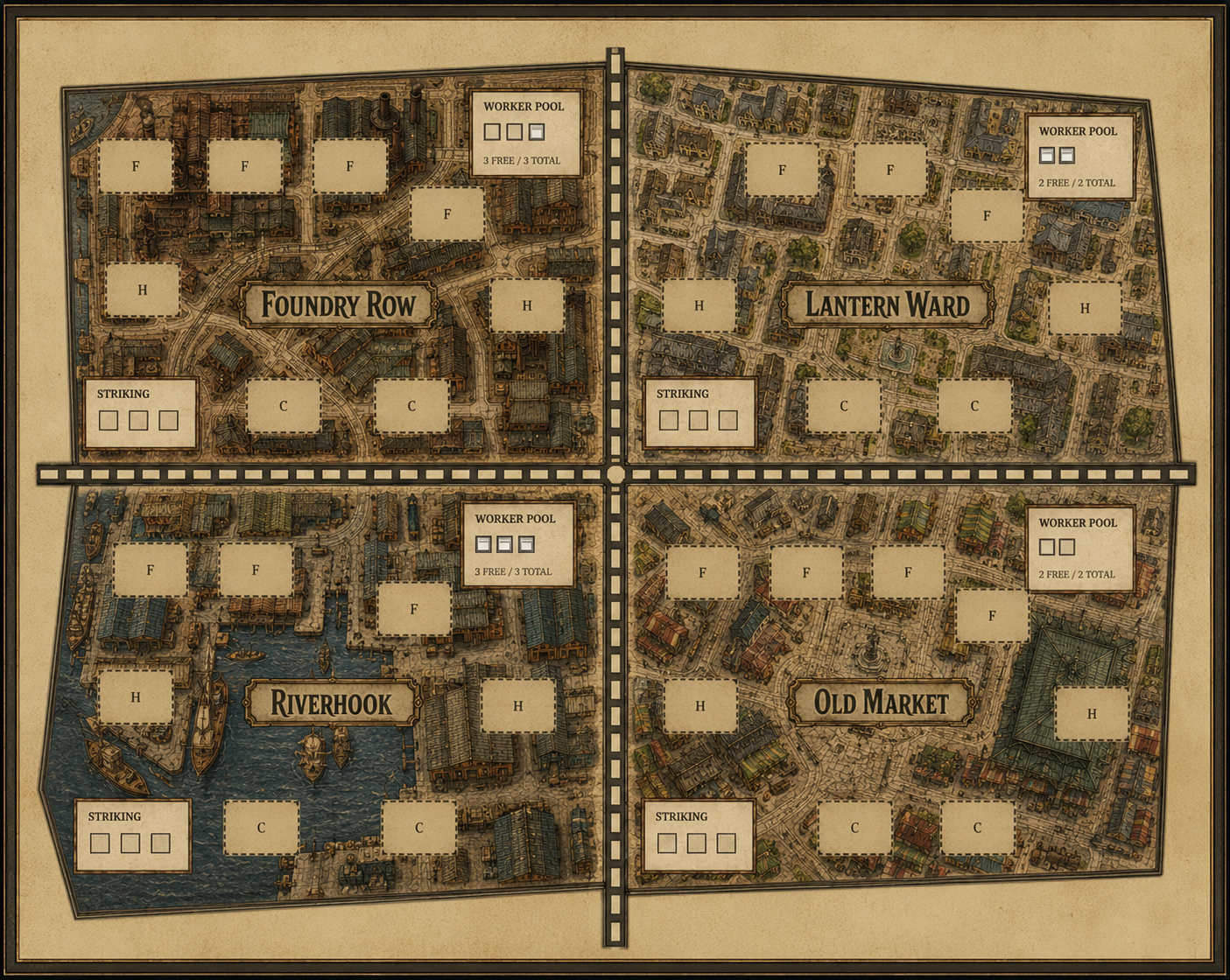
Before the first round
Setup
- Each Ward begins with 3 workers, a three-space strike track, and one neutral Factory for sale.
- Each player begins with $5, one Textile Workshop, one Boarding House, and two hidden Gangsters.
- Reveal the Construction and Official markets. Keep Gangsters face down.
- The first player begins an Invest & Build turn. The starting player alternates each round.
Cash, resources, Buildings in hand and on the board, Officials, Influence, workers, strikes, Ward control, and market cards are visible. A rival’s Gangster identities remain hidden until revealed or inspected by an effect.
How to play
Each round has two phases
Invest & Build
Players take individual turns to trade, purchase, upgrade, recruit, use Jobs, and place one Building.
Labor
Resolve every claimed Ward: contest control, allocate workers, Push production, and resolve unrest.
Cleanup occurs automatically after Labor. Workers return to their Ward pools, ongoing round effects reset, victory is checked, and the starting player changes.
Phase one
Invest & Build
During your turn, you may take the following actions in any order and as often as you can afford them:
- Buy or sell resources at the Exchange.
- Purchase Factory, Tenement, or Infrastructure cards from Construction.
- Recruit public Officials or hire hidden Gangsters from Influence.
- Upgrade a Factory or Tenement already on the board.
- Purchase a neutral Factory directly from a Ward.
- Play a legal Gangster Job or applicable card effect.
- Place one Building from your hand in a legal Ward.
The Exchange
Placing Buildings
Each Ward holds up to 4 Factories, 2 Tenements, and 2 Infrastructure Buildings. Place a card only in a matching empty space in a non-rioting Ward. Tenements and Infrastructure require one of your Factories in that Ward. Buying a card and placing it are separate actions. You may place only one Building per turn.
Buying a neutral Factory does not use your one Building placement. Infrastructure belongs to its Ward, grants its builder 1 permanent Influence, requires no workers, and supplies no Building Power.
Phase two
Labor
The starting player chooses the first claimed Ward. Resolve the four Wards clockwise from there. Unclaimed Wards are skipped.
Choose
Select the first Ward. The clockwise order is fixed for the remainder of Labor.
Contest
Every player with a Building there may compete for control.
Allocate
The winner assigns all available workers, including workers sent to rival Buildings.
Push
Roll one Labor die for every worker beyond safe staffing, plus card bonuses.
Resolve
Settle strikes and Riots, then award production if the Ward remains stable.
Contesting control
You need at least one owned Building in the Ward to enter its contest. Gangsters are committed secretly, revealed together, and discarded whether you win or lose. Ties favor the player earlier in the current round’s turn order unless a card changes the result. Control lasts until the next Labor contest in that Ward.
Allocating workers
If enough workers are available, every Factory must receive its minimum staffing before any Factory can be overworked. When workers are scarce, the controller chooses which minimums to fill. A Saboteur allows the controller to leave rival Factories unstaffed. Safely staffed Factories produce their printed resource for their owners, even when a rival controls the Ward.
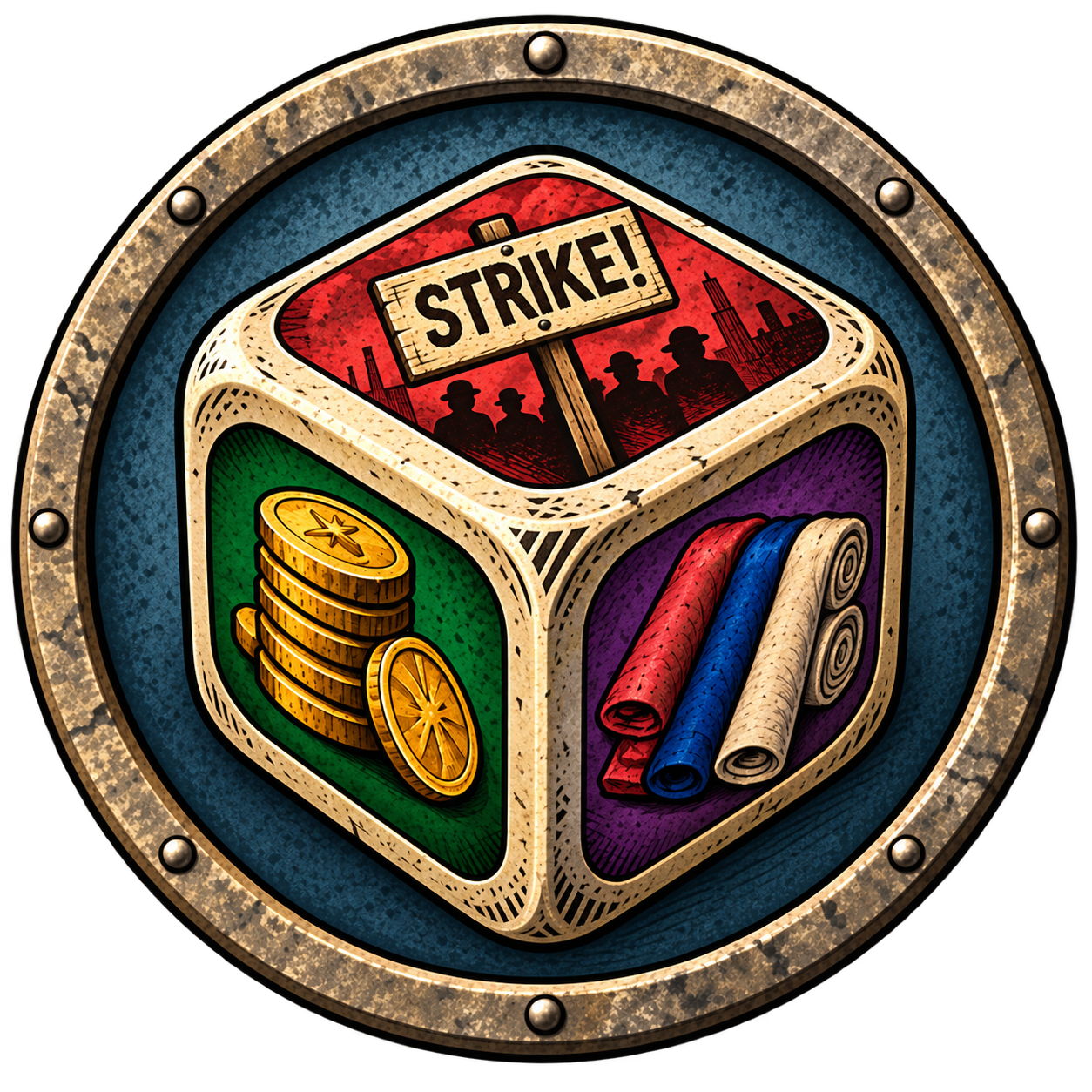
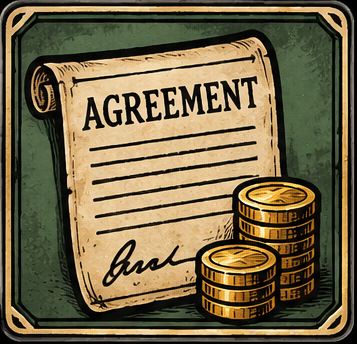 ReliefPay $2 to remove a striker
 TextileGain 1 Textile
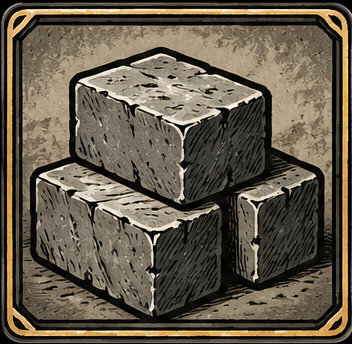 CementGain 1 Cement
 CoalGain 1 Coal
 Strike ×2Add a striker; this die locks
Factory owners receive safe production. The Ward controller receives resources shown on the Labor dice. Production and worker growth are awarded only if the Ward completes Labor without entering Riot.
Unrest
Strikes, Riots, and recovery
Three strikers ignite a Riot
A Ward in Riot produces nothing. Its controller must lose one owned Factory or Tenement there, or any Infrastructure in that Ward. Then one striker spreads to each adjacent Ward unless blocked by a Ward Checkpoint.
During a later Labor phase, contest control of a rioting Ward normally, then attempt recovery instead of production. The controller may roll up to three times. Relief removes one striker and ends the Riot. Otherwise, any Strike result ends the attempt and the Riot continues. Materials on the kept roll are collected.
Outside Labor, a card that creates a third striker triggers the Riot immediately. Resolve its Building loss and spread before play continues.
The three decks
Buildings, Officials, and Gangsters
Buildings
Factories create resources. Tenements add workers. Infrastructure changes the rules of its Ward. Owned Factories and Tenements each add 1 Ward Power.
Officials
Officials are public, persistent cards. Their Influence counts in every Ward where you own a Building and toward Consolidation. Their printed abilities remain active while you control them.
Gangsters
Gangsters are hidden and single use. Commit one to a contest, perform its Job during Invest & Build, or discard one to quell a striker anywhere—even in Riot. No more than three Gangster Jobs may affect one Ward.
Upgrades
A placed Factory or Tenement may be upgraded once for its cash upgrade cost. Upgraded Factories produce 2 resources and gain another overwork slot. Upgraded Tenements immediately add their listed workers. A destroyed upgrade is removed as a complete Building.
Quick reference
Every card
Select a category to review the cards currently used by the game. Costs and abilities below are generated from the same catalog as the markets.
End of the game
Victory and final calculations
Consolidation
After all Wards finish Labor, a player with 3 non-rioting controlled Wards and 10 Influence wins. If both players qualify, compare non-rioting controlled Wards, then Influence, then Net Worth.
Revolution
When every claimed Ward is simultaneously in Riot, calculate:
The higher total escapes the ruined city ahead. Ties favor the player who lost fewer Buildings to Riots; if still tied, the game is a draw. Ward control, workers, Gangsters, and Influence have no Net Worth value.
A card’s specific instruction takes priority over this rulebook, which takes priority over general interface text. “Cannot” takes priority over “may.”